

Domain Names vs. Web Hosting: What’s the Difference?
When creating a website, two terms you’ll encounter almost immediately are domain name and web hosting. They are closely connected, but they serve completely different purposes.
A simple way to understand the difference is:
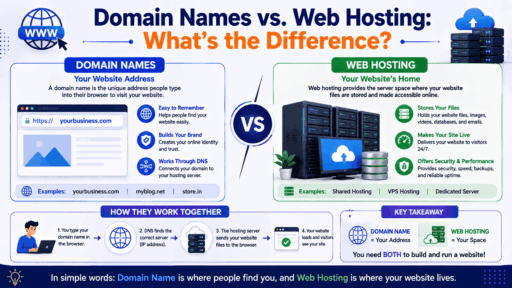
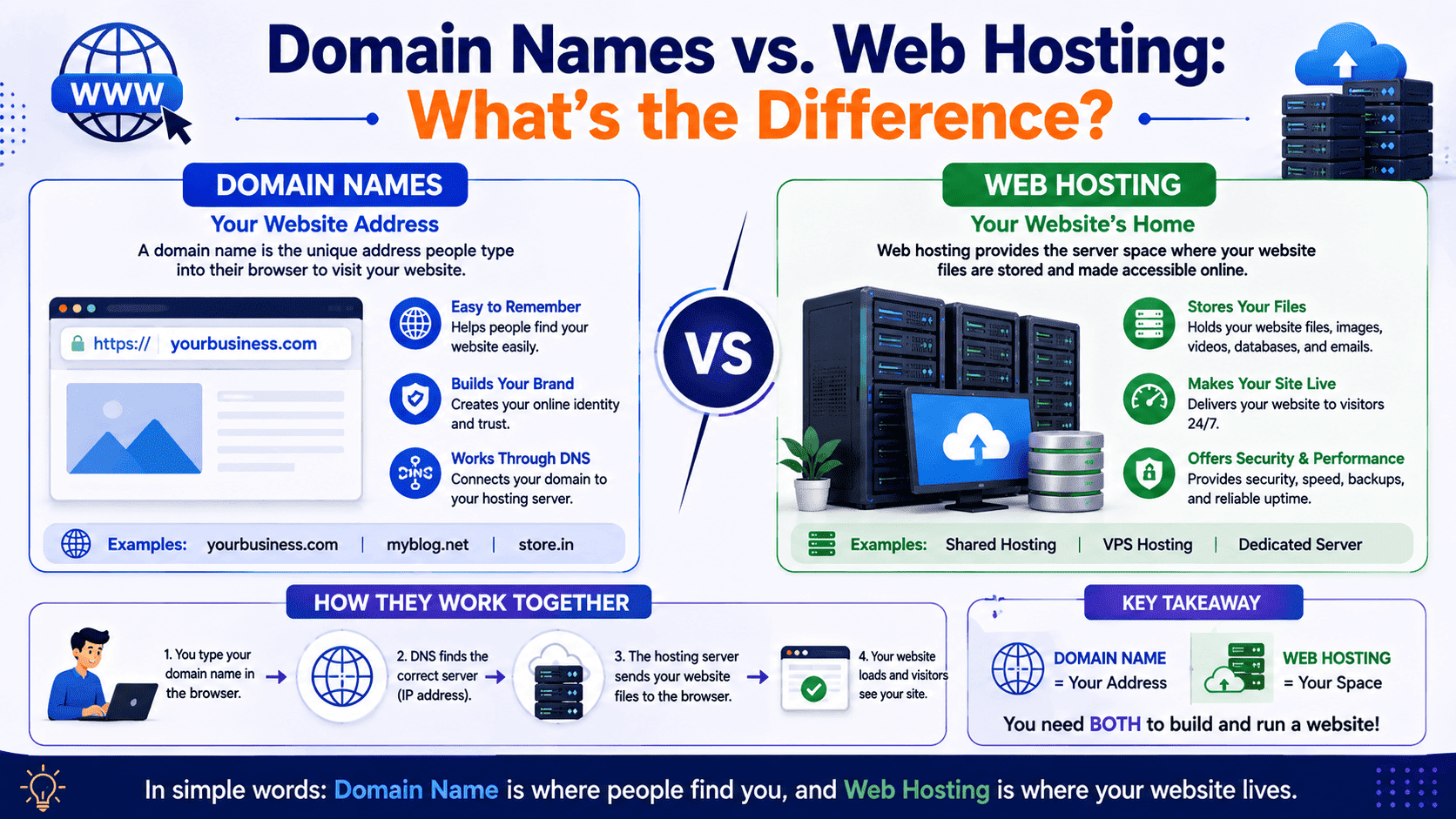
A domain name is your website’s address, while web hosting is the space where your website’s files are stored.
You generally need both to make a website accessible through a custom domain.
What Is a Domain Name?
A domain name is the human-readable address people type into their browsers to visit your website.
For example:
example.com
Behind the scenes, computers communicate using IP addresses. Domain names make those addresses easier for people to remember and use.
Instead of asking visitors to remember a numerical IP address, you can give them a simple name associated with your brand or website.
Examples of Domain Names
- yourbusiness.com
- myblog.net
- company.org
- store.in
- example.co
- ehostpiya.com
A domain can become an important part of your online identity and brand.
What Does a Domain Name Do?
A domain name primarily helps visitors find and access your website.
When someone enters your domain into a browser, the Domain Name System (DNS) helps direct the request toward the appropriate server.
The domain itself doesn’t normally contain your website’s files. It points visitors toward the infrastructure where those files are hosted.
What Is Web Hosting?
Web hosting is a service that provides the server resources needed to store and deliver your website.
Your website may contain:
- HTML files
- CSS files
- JavaScript
- Images
- Videos
- Databases
- PHP applications
- WordPress files
- Other website resources
These files need to be stored somewhere connected to the internet so that visitors can access them.
That’s where web hosting comes in.
When someone visits your website, the hosting server processes the request and delivers the required website files to the visitor’s browser.
Domain Name vs. Web Hosting
| Feature | Domain Name | Web Hosting |
|---|---|---|
| Main purpose | Website address | Stores and serves website files |
| Example | example.com | Server/storage environment |
| Contains website files? | No | Yes |
| Required for a website? | Needed for a custom domain | Needed to host the website |
| DNS involved? | Yes | Works with DNS |
| Renewal | Usually annual | Usually monthly/annual |
| Can be purchased separately? | Yes | Yes |
An Easy Real-World Example
Imagine your website is a physical store.
Your domain name is like the store’s street address.
Your web hosting is like the actual building where your products, equipment, and staff are located.
The address helps customers find you, while the building provides the physical space needed to operate the business.
Similarly:
Domain Name = Address
Web Hosting = Space
Website = Everything inside that space
How Do Domain Names and Hosting Work Together?
Suppose you purchase:
mybusiness.com
from a domain registrar and purchase a hosting plan from a hosting provider.
Your website files are stored on the hosting server.
You then configure the domain’s DNS settings to point to that hosting environment.
When a visitor enters:
mybusiness.com
the process generally looks like this:
Visitor → Domain Name → DNS → Hosting Server → Website Files → Browser
The browser receives the website resources from the hosting server and displays the website to the visitor.
Can You Buy a Domain Without Hosting?
Yes.
You can register a domain name without purchasing web hosting.
For example, you might register a domain today and decide to build your website later.
You can also use a domain for services such as:
- Business email
- Domain forwarding
- Landing pages
- Brand protection
- Future website projects
However, registering a domain alone doesn’t automatically create a website.
Can You Buy Hosting Without a Domain?
Yes.
You can purchase a hosting plan without registering a new domain.
Many hosting providers give you a temporary URL or server address that you can use while developing your website.
You can then connect your own domain later.
This can be useful when building a website before its public launch.
Do Your Domain and Hosting Need to Be From the Same Company?
No.
You can register your domain with one company and purchase hosting from another.
For example:
Domain Registrar → Company A
Web Hosting → Company B
You simply need to configure the domain’s DNS records correctly so that the domain points to your hosting server.
Using the same provider for both can be more convenient for beginners, but it isn’t technically required.
What Happens When You Change Hosting Providers?
Your domain name doesn’t necessarily need to change when you move your website to another hosting provider.
You can keep the same domain and point it to the new hosting server.
The process typically involves:
- Purchase the new hosting plan.
- Move your website files and database.
- Test the website on the new server.
- Update the domain’s DNS settings.
- Wait for DNS changes to propagate.
- Confirm that the website works correctly.
This means your domain can remain the same even when the underlying hosting provider changes.
What Is DNS?
DNS stands for Domain Name System.
It acts like a directory that helps translate domain names into information that computers use to locate online services.
DNS records can be used for different purposes, including:
- Connecting a domain to a web server
- Directing email
- Creating subdomains
- Domain verification
- Configuring third-party services
Common DNS record types include:
A Record: Points a domain or hostname to an IPv4 address.
AAAA Record: Points a hostname to an IPv6 address.
CNAME: Points one hostname to another hostname.
MX Record: Specifies mail servers responsible for receiving email.
Understanding DNS becomes especially useful when connecting a domain to hosting, email, CDN services, or other online platforms.
What Are the Different Types of Web Hosting?
Once you understand the difference between a domain and hosting, the next question is which type of hosting you need.
Shared Hosting
Multiple websites share resources on one server.
Best for: Beginners, blogs, portfolios, and small websites.
VPS Hosting
A physical server is divided into isolated virtual environments with allocated resources.
Best for: Growing websites, developers, applications, and businesses needing more control.
Dedicated Hosting
An entire physical server is assigned to one customer.
Best for: High-traffic websites, demanding applications, and businesses requiring extensive resources.
Managed WordPress Hosting
A hosting environment specifically optimized for WordPress, often with additional management and support.
Best for: WordPress users who want less technical maintenance.
Domain Name and Hosting: Which Costs More?
The cost varies depending on the provider and service.
A domain is commonly billed separately from hosting, although many hosting providers include a free domain for an initial period with selected plans.
Hosting costs depend on factors such as:
- Hosting type
- CPU and RAM
- Storage technology
- Number of websites
- Bandwidth or network limits
- Management services
- Backup options
- Security features
- Data center location
When comparing hosting plans, don’t look only at the introductory price. Check renewal pricing and additional charges as well.
Common Mistakes Beginners Make
Mistake 1: Thinking a Domain Is a Website
A domain is an address, not the website itself.
You need hosting or another website platform to provide the actual website content.
Mistake 2: Buying Hosting Without Checking Requirements
Different applications require different server environments.
Before purchasing hosting, check whether it supports your required PHP version, database system, CMS, applications, and resource requirements.
Mistake 3: Ignoring DNS Settings
Incorrect DNS configuration can prevent your domain from reaching your website or email service.
Mistake 4: Forgetting Domain Renewal
A domain registration must generally be renewed to keep control of the domain.
Mistake 5: Choosing Hosting Only by Price
A very cheap hosting plan may have limitations that aren’t obvious from the advertised price.
Consider performance, support, backups, security, resource limits, and scalability as well.
Do You Need Both a Domain and Hosting?
If you want to operate a traditional website using your own custom domain, yes, you’ll typically need both.
For example:
Domain: mybusiness.com
Hosting: Server where your website is stored
Website: WordPress, HTML, PHP application, or another platform running on that hosting
Together, they create the basic infrastructure required for your website.
Some website-building platforms bundle domain and hosting-like services into a single package, but the underlying concepts remain different.
Final Thoughts
Domain names and web hosting work together, but they are not the same thing.
Your domain name gives people a memorable address for reaching your website, while web hosting provides the server infrastructure that stores and delivers your website’s content.
Think of it this way:
Domain = Where visitors find you
Hosting = Where your website lives
DNS = The system that connects the two
Understanding this difference makes it easier to choose hosting plans, configure DNS, move websites between providers, and build a reliable online presence.