
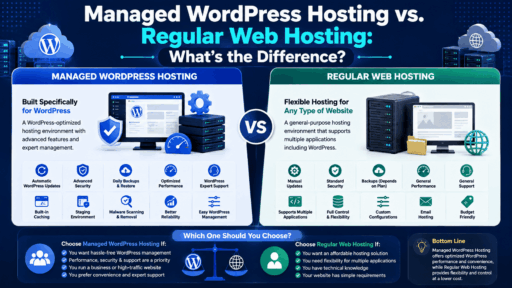
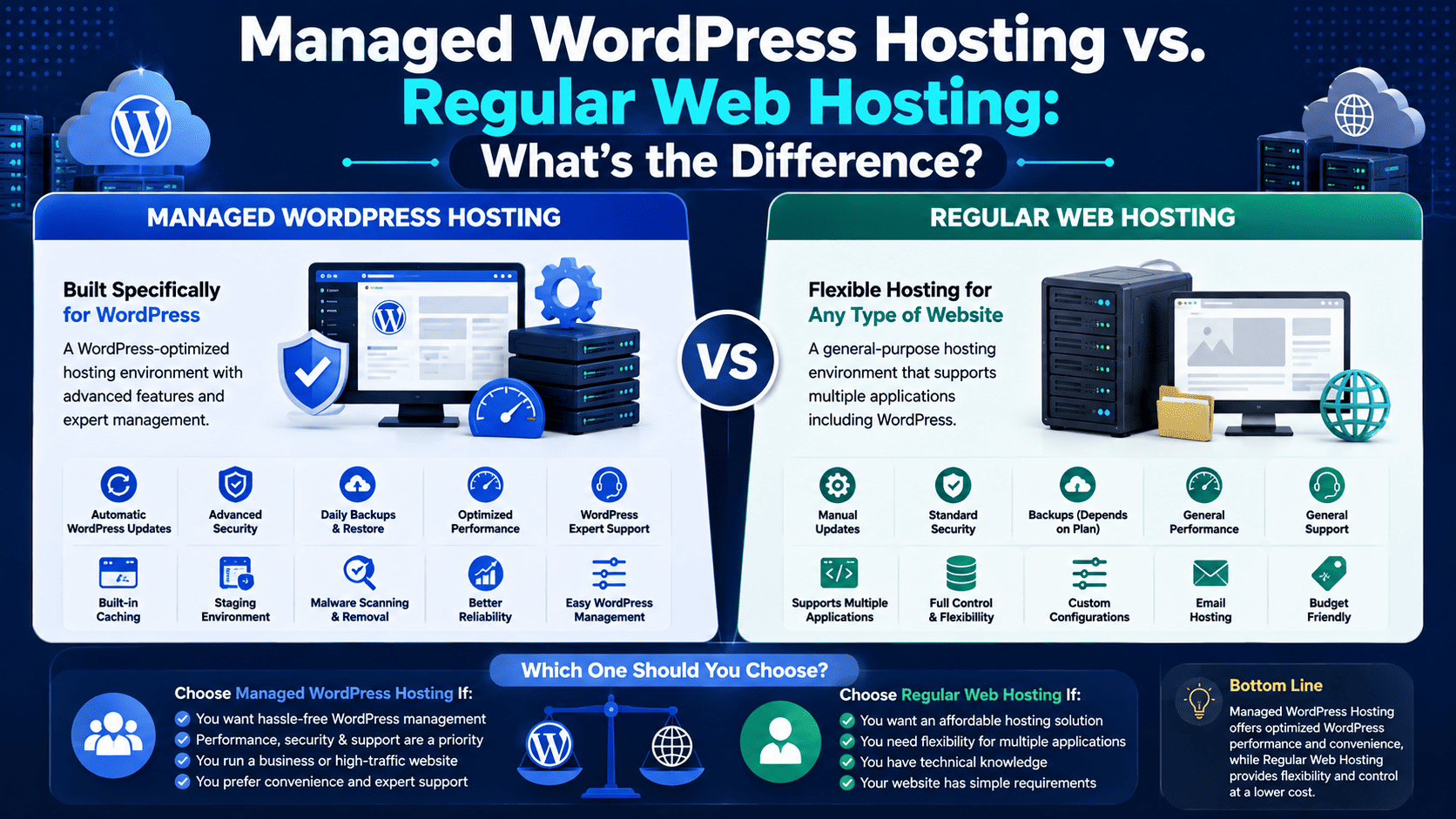

Managed WordPress Hosting vs. Regular Web Hosting: What’s the Difference?
Choosing the right hosting service can make a significant difference to your website’s performance, security, maintenance, and overall management. Two popular options are Managed WordPress Hosting and Regular Web Hosting.
Although both can host a WordPress website, they provide very different experiences. Managed WordPress hosting is built specifically around WordPress, while regular web hosting gives you a more general-purpose hosting environment.
What Is Managed WordPress Hosting?
Managed WordPress hosting is a specialized hosting service designed specifically for WordPress websites. The hosting provider takes care of many technical tasks that would otherwise need to be handled by the website owner.
Depending on the provider and plan, managed services may include WordPress updates, performance optimization, security monitoring, backups, caching, and technical support.
The goal is simple: let you focus on your website while the hosting provider handles much of the technical maintenance.
Key Features
- WordPress-focused server configuration
- Managed WordPress updates
- Automated backups
- Security monitoring
- Performance optimization
- WordPress-specific caching
- WordPress-focused technical support
- Easy staging environments on some plans
- Automatic malware scanning on some platforms
Who Should Consider It?
Managed WordPress hosting can be useful for:
- Business websites
- Online stores
- Professional blogs
- Agencies
- Content-heavy websites
- Website owners who don’t want to manage server configuration
- Businesses that prioritize convenience and support
What Is Regular Web Hosting?
Regular web hosting is a more general hosting environment that can support different types of websites and applications.
Depending on the hosting package, you may be able to run WordPress, PHP applications, HTML websites, databases, email services, and other software.
With regular hosting, the customer typically has more responsibility for managing the website itself.
Key Features
- Supports WordPress and other applications
- Flexible hosting environment
- Control panel access
- Email hosting on many plans
- Database support
- File management
- PHP version selection
- SSL support
- More flexibility for different applications
Who Should Consider It?
Regular web hosting can be a good option for:
- Small business websites
- Personal websites
- Blogs
- Developers
- Multiple types of websites
- Users who want more control
- Budget-conscious website owners
Managed WordPress vs. Regular Web Hosting
| Feature | Managed WordPress Hosting | Regular Web Hosting |
|---|---|---|
| WordPress optimization | High | Depends on provider |
| WordPress maintenance | Often included | Usually customer-managed |
| Automatic updates | Often available | Usually limited |
| Backups | Often included | Depends on plan |
| Security | WordPress-focused | General server security |
| Performance tuning | WordPress-specific | General optimization |
| Flexibility | WordPress-focused | Higher |
| Other applications | Usually limited | Usually supported |
| Technical expertise | Lower | Moderate |
| Support | WordPress-focused | General hosting support |
| Cost | Usually higher | Usually lower |
| Best for | WordPress-focused websites | General-purpose websites |
1. Performance
Managed WordPress hosting is generally configured with WordPress workloads in mind. The server environment may include WordPress-specific caching, optimized PHP settings, database tuning, and content delivery integrations.
Regular hosting can also deliver excellent performance, but optimization may be more general rather than specifically designed around WordPress.
Winner for WordPress-specific optimization: Managed WordPress Hosting
2. Security
Security is important for every WordPress website because outdated plugins, themes, weak passwords, and vulnerable configurations can create risks.
Managed WordPress providers may offer features such as WordPress security monitoring, malware scanning, automated updates, firewall protection, and backups.
Regular hosting can provide strong server-level security, but you may need to take more responsibility for keeping WordPress, plugins, and themes updated.
Winner for convenience: Managed WordPress Hosting
3. Maintenance
One of the biggest differences is how much maintenance you need to perform.
With regular hosting, you generally manage WordPress updates, plugins, themes, backups, optimization, and troubleshooting yourself.
Managed WordPress hosting can automate or assist with many of these tasks.
This makes managed hosting particularly attractive to business owners who would rather spend their time creating content and managing customers than maintaining servers.
4. Flexibility
Regular web hosting usually wins when flexibility is the priority.
A regular hosting account may allow you to install WordPress alongside other PHP applications, scripts, databases, and custom software.
Managed WordPress hosting is more specialized. That specialization can simplify WordPress management, but it may also impose restrictions on certain plugins, server configurations, or applications.
Winner for flexibility: Regular Web Hosting
5. Cost
Managed WordPress hosting generally costs more because the provider is offering additional WordPress-specific services and management.
Regular web hosting is often cheaper and can be an excellent choice for websites that don’t need specialized WordPress management.
However, the cheapest hosting plan isn’t necessarily the cheapest solution in the long run. Time spent troubleshooting, updating, securing, and optimizing a website also has value.
Which One Should You Choose?
Choose Managed WordPress Hosting If:
- Your website runs primarily on WordPress
- You want less technical maintenance
- Performance is important
- You want WordPress-focused support
- Automated backups and updates are valuable to you
- You run a business or professional website
- You prefer convenience over server-level flexibility
Choose Regular Web Hosting If:
- You want an affordable hosting solution
- You manage your own WordPress updates
- You need to host different types of applications
- You want greater flexibility
- You have some technical knowledge
- Your website has straightforward hosting requirements
A Simple Example
Imagine you own a small business website.
With regular web hosting, you may be responsible for installing WordPress, configuring caching, updating plugins, managing backups, monitoring security, and troubleshooting issues.
With managed WordPress hosting, many of these tasks can be handled or assisted by the hosting provider.
So the difference isn’t simply where your website is hosted. It is also how much of the technical workload you want the hosting provider to handle.
Final Verdict
There is no universally better option.
Managed WordPress hosting is ideal when you want a WordPress-focused environment with more automation, optimization, and support.
Regular web hosting is better when you want affordability, flexibility, and greater control over how your hosting environment is used.
In simple terms:
Managed WordPress Hosting = Less maintenance + WordPress-focused optimization
Regular Web Hosting = More flexibility + Greater control + Often lower cost
Before choosing a plan, look beyond the advertised storage and bandwidth. Compare backup policies, security features, server resources, support quality, scalability, performance tools, and renewal pricing to determine which hosting environment provides the best overall value for your website.