
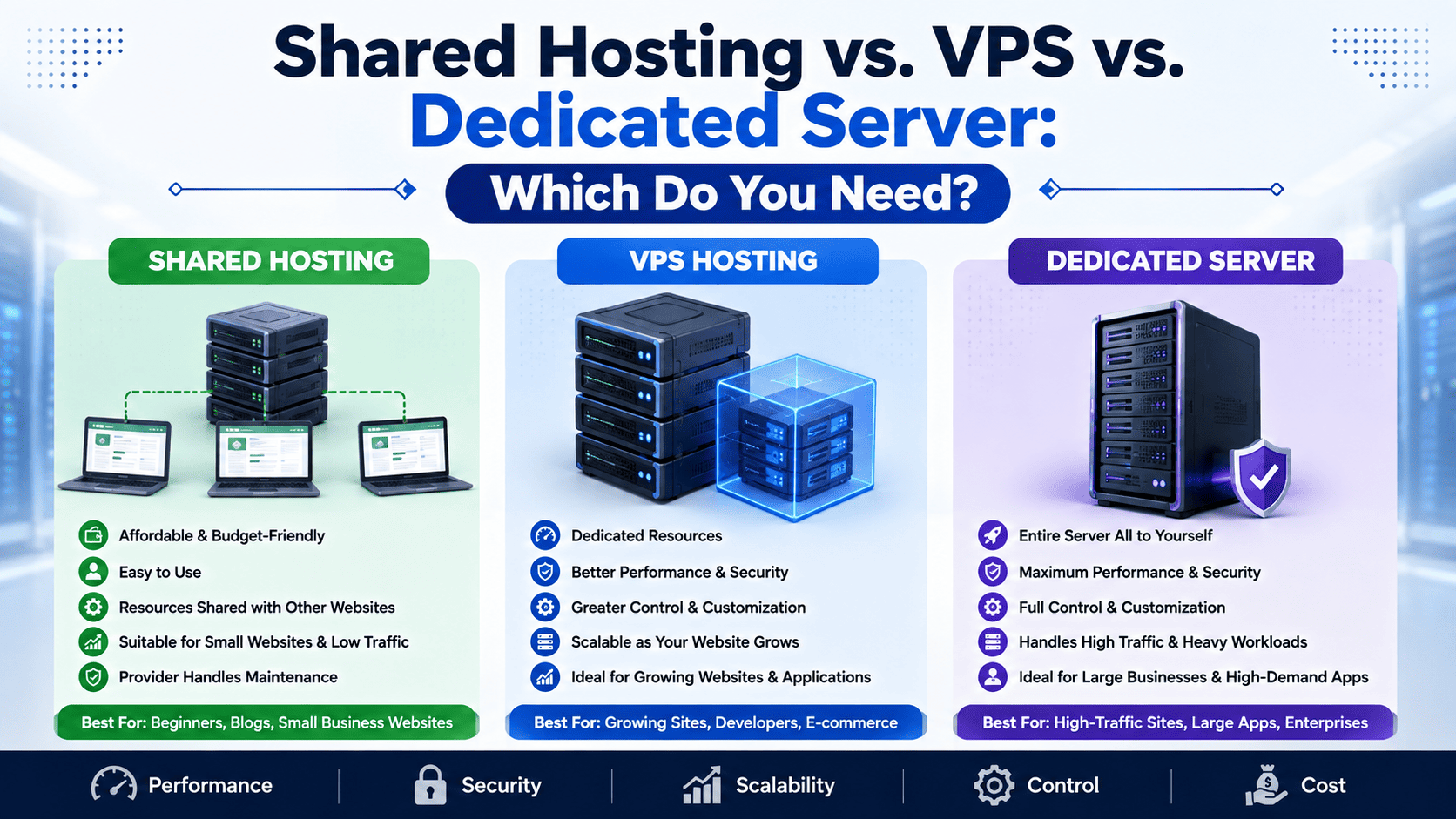

Shared Hosting vs. VPS vs. Dedicated Server: Which Do You Need?
Choosing the right hosting environment is one of the most important decisions when launching or growing a website. Your hosting plan affects performance, scalability, security, control, and cost.
Three of the most common options are shared hosting, VPS hosting, and dedicated servers. Although all three can host websites and applications, they are designed for very different requirements.
1. Shared Hosting
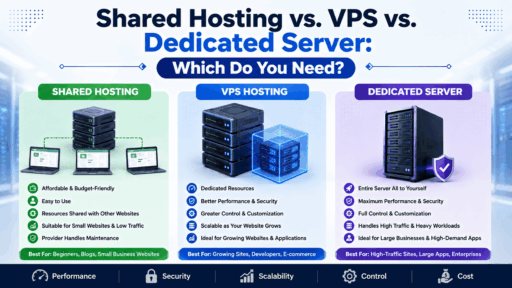
Shared hosting is the most beginner-friendly hosting option. Multiple websites are hosted on the same physical server and share resources such as CPU, RAM, storage, and network capacity.
It is similar to living in an apartment building: you have your own space, but the building’s resources are shared with other residents.
Advantages of Shared Hosting
- Affordable and budget-friendly
- Easy to manage
- Usually includes a control panel
- Server maintenance is generally handled by the hosting provider
- Suitable for smaller websites
- Often includes features such as SSL, email, backups, and application installers
Disadvantages
- Resources are shared with other websites
- Performance can be affected by busy accounts on the same server
- Limited server-level customization
- Less control than VPS or dedicated hosting
- May not be suitable for high-traffic applications
Best For
Shared hosting is a good choice for:
- Personal websites
- Blogs
- Portfolio websites
- Small business websites
- New WordPress websites
- Websites with relatively low traffic
2. VPS Hosting
VPS stands for Virtual Private Server. A physical server is divided into multiple virtual environments, with each VPS receiving its own allocated resources.
A VPS provides more control and isolation than shared hosting while generally costing less than a dedicated server.
Think of it like owning a private apartment within a larger building. You share the physical building, but your allocated environment is more isolated and configurable.
Advantages of VPS Hosting
- Dedicated allocation of resources
- Better performance than typical shared hosting
- Greater control over the server environment
- Root or administrative access is often available
- Better scalability
- Suitable for custom software and configurations
- Can handle growing traffic more effectively
Disadvantages
- More expensive than shared hosting
- Requires more technical knowledge, particularly with unmanaged VPS plans
- Server administration may be your responsibility
- Resource limits still exist
Best For
VPS hosting is suitable for:
- Growing business websites
- Busy WordPress websites
- E-commerce stores
- Web applications
- Developers
- SaaS applications
- Websites requiring custom server configurations
- Businesses that have outgrown shared hosting
3. Dedicated Server
With dedicated hosting, an entire physical server is assigned to one customer. You don’t share the server’s CPU, RAM, storage, or network resources with other customers.
This provides the highest level of control and resource availability among these three hosting options.
A dedicated server is similar to owning an entire building instead of renting a room or apartment.
Advantages of Dedicated Hosting
- Entire server dedicated to one customer
- Maximum control over the environment
- High and predictable resource availability
- Excellent performance potential
- Advanced server customization
- Suitable for demanding applications
- Strong option for high-traffic websites
Disadvantages
- Higher cost
- Requires more technical expertise
- Server management can be complex
- Overkill for small websites
- Hardware and operating-system management may require additional responsibilities
Best For
Dedicated servers are generally suitable for:
- High-traffic websites
- Large e-commerce platforms
- Enterprise applications
- Large databases
- Resource-intensive applications
- Gaming and specialized servers
- Businesses requiring extensive server control
Shared Hosting vs. VPS vs. Dedicated Server
| Feature | Shared Hosting | VPS Hosting | Dedicated Server |
|---|---|---|---|
| Cost | Low | Medium | High |
| Server resources | Shared | Allocated | Entire server |
| Performance | Basic–Good | Good–Excellent | Excellent |
| Customization | Limited | High | Very High |
| Root/Admin access | Usually limited | Usually available | Available |
| Scalability | Limited | High | Very High |
| Management difficulty | Easy | Moderate | Advanced |
| Best for | Small websites | Growing websites | High-demand applications |
How Do You Choose?
The best hosting solution depends on your website’s current requirements rather than simply choosing the most powerful server available.
Choose Shared Hosting If…
You are starting a website, have a limited budget, and don’t need advanced server configuration. For a simple blog, portfolio, or small business website, shared hosting can provide everything you need without unnecessary complexity.
Choose VPS Hosting If…
Your website has outgrown shared hosting or requires more resources and control. VPS hosting is often the middle ground between affordability and performance.
It can be particularly useful when you need custom software, increased resource limits, better isolation, or administrative access.
Choose a Dedicated Server If…
Your application requires substantial resources, consistent performance, or extensive server customization. Dedicated hosting makes more sense when the workload is large enough to justify having an entire physical server.
A Simple Way to Think About It
Shared Hosting → VPS → Dedicated Server
As you move from shared hosting toward dedicated hosting, you generally gain:
More resources → More control → More customization → Higher cost
However, more powerful hosting isn’t automatically better. Paying for a dedicated server when your website only needs a small amount of resources can result in unnecessary expenses.
Can You Upgrade Later?
Yes. Hosting requirements can change as your website grows.
A typical progression might look like:
New Website → Shared Hosting → VPS → Dedicated Server
You can begin with an affordable hosting plan and upgrade when traffic, resource usage, application complexity, or business requirements increase.
Final Verdict
There is no single hosting solution that is perfect for every website.
Shared hosting is ideal when affordability and simplicity are the priorities.
VPS hosting is a strong choice when you need additional resources, flexibility, and control.
Dedicated servers are best when your website or application demands substantial resources and maximum server control.
The right choice is the one that provides enough performance, reliability, scalability, and control without paying for resources you don’t actually need.