

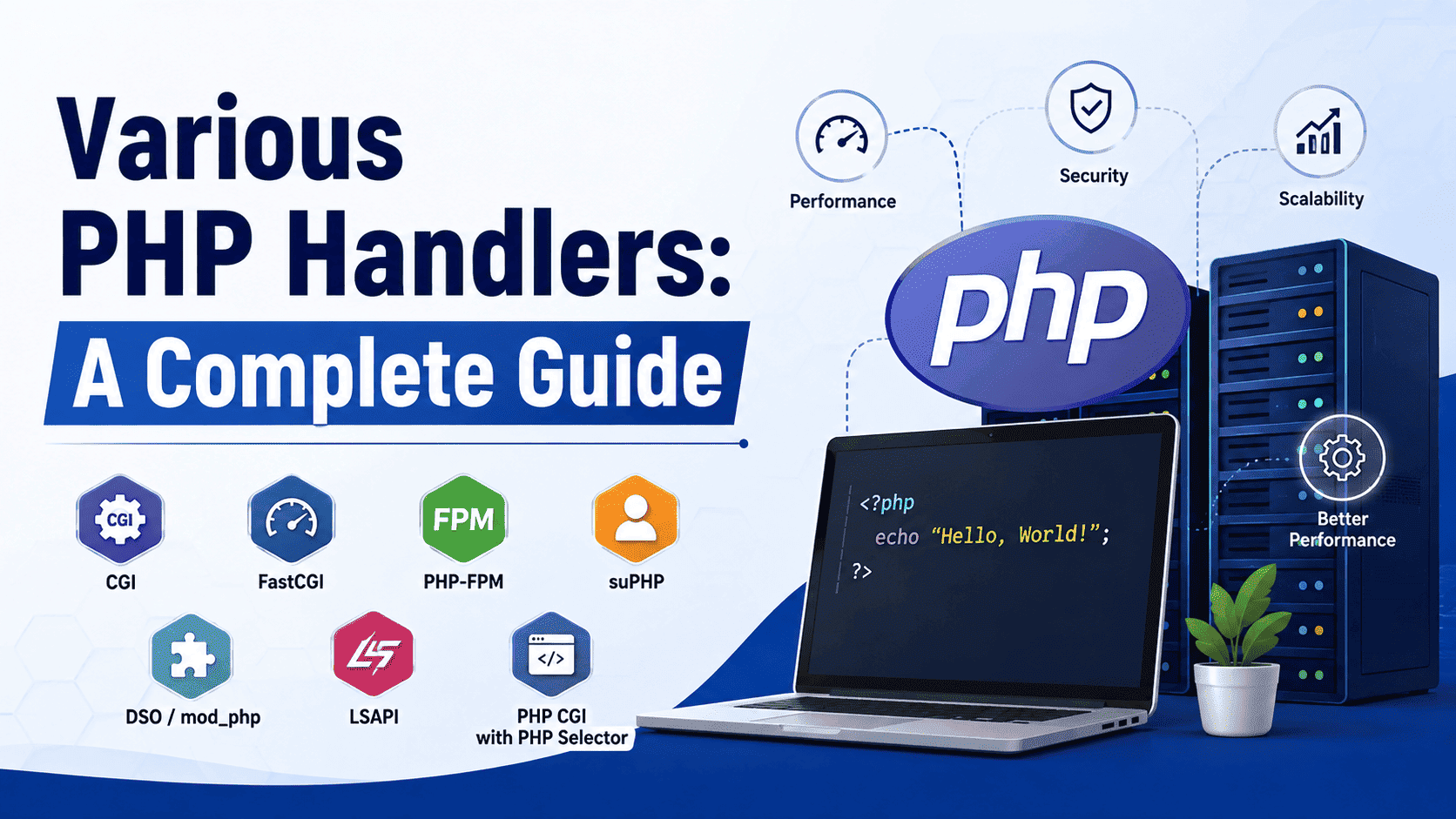

Various PHP Handlers: A Complete Guide
PHP handlers determine how a web server processes PHP files and executes PHP code. Choosing the right PHP handler can affect website performance, memory usage, security, compatibility, and server resource consumption.
Different hosting environments use different PHP handlers depending on the web server, PHP version, traffic level, and hosting architecture.
1. CGI (Common Gateway Interface)
CGI is one of the oldest methods for running PHP applications. With CGI, the web server starts a separate PHP process whenever a PHP request needs to be processed.
Advantages:
- Simple and widely supported
- Provides good process isolation
- Can work with different PHP versions
Disadvantages:
- Creates a new process for requests
- Higher resource consumption
- Generally slower than modern PHP handlers
CGI may still be useful in specific hosting environments, but it is less common for high-traffic websites.
2. FastCGI
FastCGI improves upon traditional CGI by keeping PHP processes running instead of creating a new process for every request. The web server communicates with persistent PHP processes to execute scripts.
Advantages:
- Faster than traditional CGI
- Better performance under traffic
- Reduces process creation overhead
- Can support multiple PHP versions
Disadvantages:
- Requires additional configuration
- PHP process management needs to be handled properly
FastCGI can be a good choice for websites that need better performance while retaining flexible server configurations.
3. PHP-FPM
PHP-FPM (PHP FastCGI Process Manager) is one of the most widely used PHP processing methods today. It is built specifically to manage PHP processes efficiently and works through the FastCGI protocol.
PHP-FPM maintains pools of PHP worker processes and distributes incoming requests among them.
Advantages:
- Excellent performance
- Efficient process management
- Supports multiple PHP versions
- Configurable worker pools
- Better control over CPU and memory usage
- Suitable for high-traffic websites
PHP-FPM is commonly used with web servers such as Nginx and Apache.
4. suPHP
suPHP is designed to execute PHP scripts under the user account that owns the website rather than a shared web-server user.
This can provide useful separation between hosting accounts.
Advantages:
- Improved account-level isolation
- PHP scripts run with the website owner’s permissions
- Useful for shared hosting environments
Disadvantages:
- Slower than PHP-FPM in many configurations
- Creates additional process overhead
- Less commonly used on modern hosting platforms
suPHP was historically popular in shared hosting but has largely been replaced by newer approaches.
5. DSO / mod_php
DSO, commonly associated with mod_php, loads PHP directly into the Apache web server.
Because PHP runs inside Apache, there is less communication overhead between the web server and PHP interpreter.
Advantages:
- Simple Apache integration
- Good performance in some environments
- Easy to configure on traditional Apache installations
Disadvantages:
- PHP runs within Apache processes
- Can consume significant server memory
- Less flexible for running multiple PHP versions
- Can create permission and security considerations in shared hosting
DSO can still be appropriate for certain Apache-based servers, but PHP-FPM is generally preferred for modern deployments.
6. LSAPI
LiteSpeed Server API (LSAPI) is a PHP processing interface designed for LiteSpeed Web Server. It is optimized to work efficiently with LiteSpeed’s architecture.
LSAPI can provide strong performance and efficient resource utilization, particularly on hosting servers running LiteSpeed.
Advantages:
- High performance
- Efficient PHP process management
- Good scalability
- Designed for LiteSpeed environments
- Works well with popular CMS platforms such as WordPress
For hosting providers using LiteSpeed, LSAPI is an important PHP handler to consider.
7. PHP CGI with PHP Selector
Some shared hosting platforms allow users to select their PHP version through a control panel while the server uses a CGI-based PHP handler underneath.
This approach provides flexibility for hosting customers who operate websites requiring different PHP versions.
Advantages:
- Easy PHP version selection
- Useful for shared hosting
- Supports applications with different PHP requirements
Disadvantages:
- Performance depends on the underlying CGI implementation
- Configuration can vary between hosting platforms
PHP Handler Comparison
| PHP Handler | Performance | Resource Efficiency | Multiple PHP Versions | Common Usage |
|---|---|---|---|---|
| CGI | Low–Moderate | Low | Yes | Legacy/specific setups |
| FastCGI | Good | Good | Yes | Web hosting |
| PHP-FPM | Excellent | Excellent | Yes | Modern hosting |
| suPHP | Moderate | Moderate | Yes | Older shared hosting |
| DSO/mod_php | Good | Moderate | Limited/Flexible with setup | Apache servers |
| LSAPI | Excellent | Excellent | Yes | LiteSpeed hosting |
Which PHP Handler Should You Choose?
For most modern hosting environments, PHP-FPM or LSAPI are strong choices because they provide efficient PHP process management and can handle demanding websites effectively.
For a traditional Apache environment, PHP-FPM offers flexibility and good scalability. If you are running LiteSpeed Web Server, LSAPI can be an excellent option.
The ideal PHP handler ultimately depends on your web server, hosting architecture, traffic levels, PHP application, and resource requirements.
Final Thoughts
PHP handlers work behind the scenes, but they can have a major impact on website performance. While CGI and suPHP remain relevant in certain legacy environments, modern hosting platforms increasingly rely on PHP-FPM, FastCGI, and LSAPI for better performance and scalability.
For a hosting provider, selecting the right PHP handler can help deliver faster page processing, better resource management, improved scalability, and a smoother experience for customers.